Hydraulic excavator — cut, fill and bucket tamping
A simulated 50 t class excavator cuts material from a dense bank, places it in a walled pit in two lifts, levels each lift with the back of the bucket, and tamps it with the flat base of the bucket. The overlay follows the fill's bulk density and the bank, loose and compacted volumes as the work goes on.
The material is about 141,000 rigid grains of 80 mm, with friction, rolling resistance and cohesion between grains. The excavator's boom, arm, bucket and swing are driven through a hydraulic model with relief limits, and every grain contact pushes back on the machine. Each tamp lowers the bucket until the grains push back with 85 kN (46 kPa over the 1.84 m² underside of the bucket), holds, and lifts. That force is set from the machine model with a generic undercarriage: at every tamping position it stays below the force at which the tracks would start to lift.
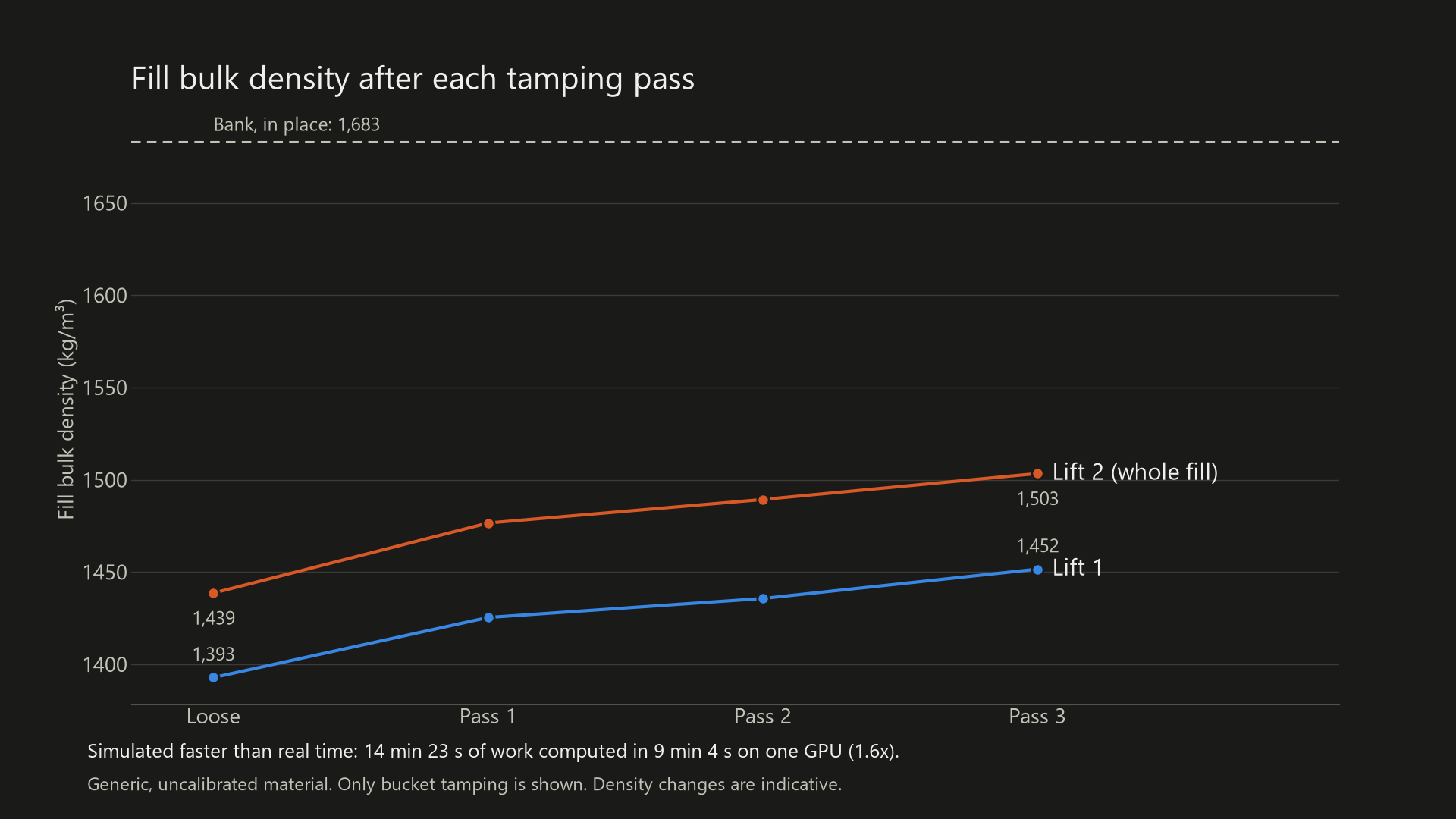
The bank, in place, is at 1,683 kg/m³. The first lift was at 1,393 kg/m³ once levelled, then 1,425, 1,436 and 1,452 kg/m³ after tamping passes 1 to 3 (+4.2%), from 10.2 m³ loose to 9.8 m³ tamped. With the second lift on top, the whole fill was at 1,439 kg/m³ levelled, then 1,477, 1,489 and 1,503 kg/m³ after passes 1 to 3 (+4.5%), from 18.6 m³ loose to 17.8 m³ tamped. In all, 26.7 t was moved from the bank (15.9 m³ in place), and 6 kg was spilled outside the bank and the pit.
The simulation runs faster than real time on one NVIDIA GeForce RTX 5090: 14.4 minutes of work took 9.1 minutes to compute (1.59×). The slowest phase, digging, ran at 1.26× real time on its median frame. Each 20 ms frame of grains and machine is timed, and 43,101 of 43,128 frames (99.94%) were computed within 20 ms. The images were rendered afterwards and are not in this timing. The clip plays at 8.4× speed and ends on the density chart below.
The material is generic and uncalibrated. Only bucket tamping is shown, and the density changes are indicative. The grains are one size; a graded soil packs and compacts differently. The machine model is a generic 50 t class excavator.
Simulated with NDEM, our real-time granular engine.
Robotics team doing granular simulation?
If you're building robots that dig, load, or move bulk material, send us a geometry or a scenario — we'll show you what it looks like in NDEM: real-time and calibrated to real materials.